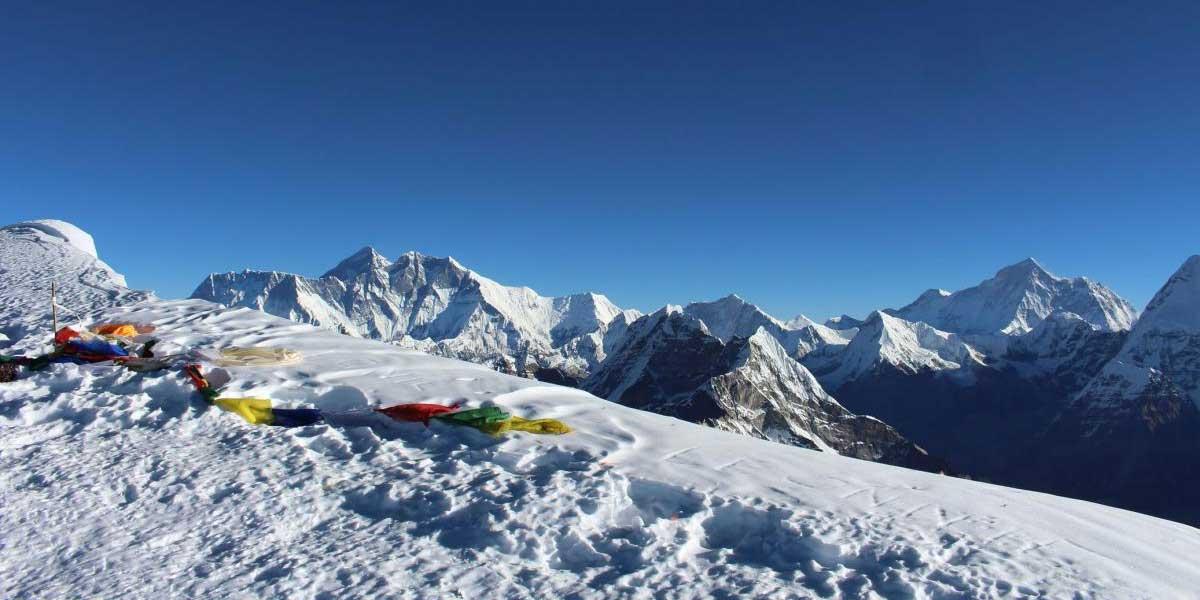
An ascent expedition on Mera Peak is probably an adventure of the lifetime. Setting foot on the highest climbing peak towering at the elevation of 6,461m is not an easy task. Only those who dream and dare to conquer one of the Himalayan peaks possess the ability to reach the top of Mera Peak. Mera Peak climbing is an adventure in itself, but the extension to cross the Amphu Laptsa Pass (5,846m) aka Mingbo La pass in Sherpa dialect function as icing on the cake. This addition delivers a charm to the peak climbing expeditions and allows individuals to range over faraway mountainous inhospitable region across a remarkable pass. Eventually, the route makes a round turn back past Sagarmatha National Park. Mera Peak Climbing and Amphu Laptsa Pass empowers travel enthusiasts with the essence of thrill and delight in the widely celebrated Khumbu region. Deeply admired by mountain climbers and seasoned trekkers; Mera Peak Climbing and Amphu Laptsa Pass bestow outlook of snowy mountaintops comprising Makalu, Ama Dablam, Island Peak, Mera peak, Mount Everest, Lhotse, Nuptse and many more. Besides that, one can experience the flavour of legendary Sherpa hospitality. Along with that, visitors also obtain unmediated exposure to ethnic culture, traditions, and values of native Sherpa communities.
Categorized as non-technical climbing peak; Mera Peak is situated in Solukhumbu district of Eastern Nepal. It boasts considerable elevation and extends difficulties such as extreme cold and winds while climbing all the way to top through high glaciers, fresh snow and crevasses. A non-climber an also sign-up for Mera Peak expedition but one needs to have basic mountaineering skills and a certain degree of trekking experience along with a good level of physical and mental ability. Succeeding a picturesque flight to Lukla, we commence our trek and traverse small human settlements, rhododendron woodlands to Chutang where we’ll have our first day exclusively dedicated for acclimatization. Resuming our trek, we now pursue the trail, which advances across Zatwra La Pass (4,600m) to Thuli Kharka. Afterwards, the trail enters Hinku Valley and progress along the Hinku River and traverses the settlements of Kothe, and Tagnag to Khare. Khare is our spot for the second acclimatization as well as it is the very place where we practice ice climbing as a warm-up for the upcoming escapade. Subsequently, we’ll make our way to Mera Peak Base Camp then continue to Mera High Camp and ultimately arrive at the summit. Here, we can witness a spell-binding panorama including snowy peaks such as Everest (8,848m), Cho-Oyu (8201m), Lhotse (8,516m), Makalu (8,463m), Kanchenjunga (8,586m), Nuptse (7,855 m), Chamlang (7,319 m) and many more. After experiencing the thrill, joy, and a bit proud of the recent achievement; we descend to Kongma Dingma and have a pre-planned extra contingency day. Thereafter, we trek across Kongma Dingma to Seto Pokhari and towards unoccupied and isolated Honku Valley. Then, we advance beyond technical and challenging Amphu Laptsa Pass and trek towards Chhukung. Eventually, we reach Namche Bazar and continue down to Lukla.
The most favourable season for this trek is spring in the month of April to May and in autumn for the month of September to November. Acclimatization is the key to accomplish the escapade successfully. Thus, valuing your safety and satisfaction, we present you our Mera Peak Climbing and Amphu Laptsa Pass trek in order to enable you to live the Everest dream!!!
The most favourable season for this trek is spring in the month of April to May and in autumn for the month of September to November. Acclimatization is the key to accomplish the escapade successfully. Thus, valuing your safety and satisfaction, we present you our Mera Peak Climbing and Amphu Laptsa Pass trek in order to enable you to live the Everest dream!!!
This is the short version of the Annapur
The daunting experience of landing on th
Trekking can be a very addictive adventu
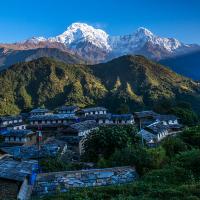
The scenic views of the Himalayas have a
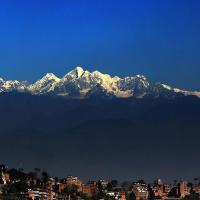
Nepal, famously known as the land of the
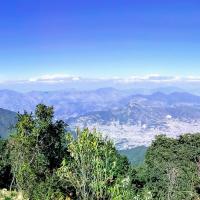
The journey starts from the capital stra